Market Digest - October 2026
Updated: 13 hours ago
Edition: October 2026 Edition — Published October 07, 2026
Executive Perspective (At a Glance)
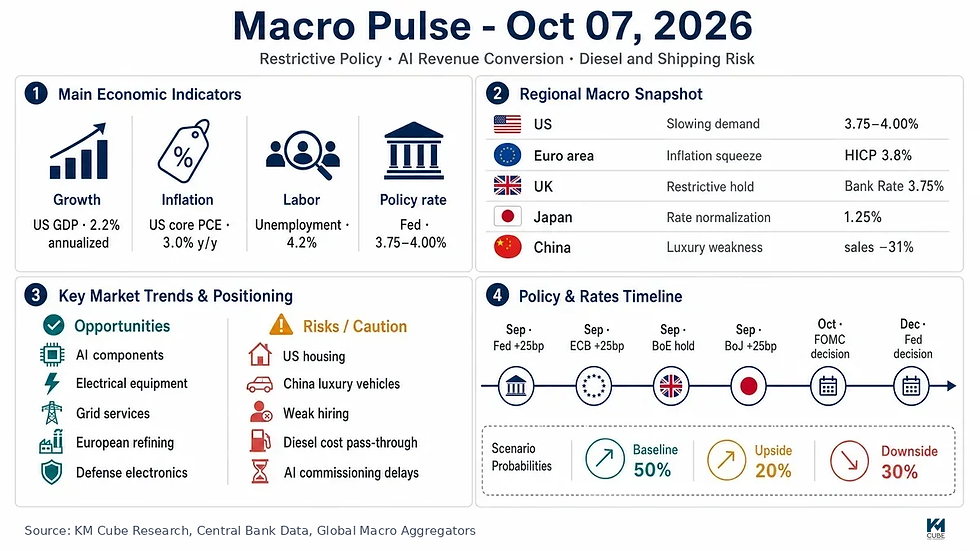
Macro Regime: The global macroeconomic landscape is characterized by a restrictive-policy slowdown rather than an easing-led recovery. While capital expenditure in artificial intelligence hardware and energy infrastructure remains robust, softening labor momentum (U.S. nonfarm payrolls rising just 29k with unemployment at 4.2%) is narrowing the cushion against persistent inflation. In this environment, capital allocation prioritizes suppliers with verified delivery economics, secured grid interconnection, and demonstrated cash generation over speculative backlog growth.
Policy & Rates Divergence: Central banks maintain elevated hurdle rates for long-duration assets. The Federal Reserve holds a restrictive stance in the 3.75–4.00% target range with markets pricing a pause with a tightening bias, while long-term benchmark yields continue to exert pressure on debt refinancing. Simultaneously, euro-area flash HICP at 3.8% reinforces the European Central Bank's tightening discipline at a 2.50% deposit rate, and the Bank of England sustains a restrictive 3.75% Bank Rate alongside active balance-sheet reduction.
Discretionary House Stance: Discretionary allocations maintain a disciplined neutral risk posture, curbing exposure to financing-sensitive cyclical consumption (housing, automotive, consumer finance) in favor of mission-critical grid components, high-density cooling infrastructure, and defensive balance sheets. Capital preservation is reinforced by combining short-to-intermediate EUR duration with systematic trend overlays and multi-issuer structured yield harvesting.
Cross-Asset & Strategy Allocation Matrix
Asset Class / Strategy Mandate | House Stance | Macro Driver | Discretionary Portfolio Implementation |
Core EUR Fixed Income & Duration | [Defensive] | Sticky energy-driven inflation (flash HICP 3.8%) and restrictive ECB stance limit sovereign hedging efficacy. | Concentrate in short-to-intermediate duration (3–5 years) across European high-grade sovereign and investment-grade corporate bonds, locking in attractive carry while avoiding uncompensated term premium risk. |
Systematic Equities & Trend Overlays | [Overweight] | Structural capex in AI semiconductors, power grid automation, and cooling equipment converting into operational cash flow. | Systematic trend and momentum models dynamically focus on industrial suppliers with order backlog escalation protection, while systematically underweighting affordability-sensitive housing and consumer cyclicals. |
Structured Yield & Volatility Premium | [Overweight] | Structural yield curve volatility and elevated base rates create resilient coupon-capture conditions. | Multi-issuer managed certificate ladders harvesting volatility premia with conservative 25–30% downside barrier buffers, generating steady yield without direct single-equity exposure. |
Alternative Risk Premia & Factor Allocations | [Neutral] | Dispersed equity performance, elevated input costs, and risks of simultaneous equity-bond drawdowns. | Institutional quantitative models capturing Quality, low financial leverage, and defensive carry, prioritizing companies with robust pricing power and uncompromised operating margins. |
Currencies & Liquidity (EUR vs. USD) | [Hedged] | USD yield differential balanced against domestic EUR liabilities and cross-currency hedging friction. | Controlled, systematically hedged USD exposure, preserving liquid EUR buffers for opportunistic redeployment as financing stresses develop. |
Thematic Conviction: Where Scarcity Meets Capital
1. The Energy-Compute Bottleneck: Grid Modernization & Cooling Architecture
The structural expansion of artificial intelligence infrastructure is encountering physical boundary conditions: power availability, substation capacity, and high-voltage interconnect queues. Order backlog growth is no longer a sufficient indicator of corporate resilience; margins and delivery execution separate durable operators from businesses exposed to fixed-price cost overruns. Discretionary allocations favor specialized manufacturers of high-voltage transformers, grid switchgear, automation systems, and advanced liquid cooling. These enablers possess multi-year order visibility backed by contractual cost pass-through mechanisms, capturing secular capex without exposure to speculative end-market adoption risks.
2. Supply-Chain Disruption & Middle Eastern Transit Realities
Ongoing maritime disruptions across vital global transit corridors continue to inject volatility into European refining, diesel availability, and landed chemical feedstock costs. While elevated freight rates burden energy-intensive manufacturers and transport logistics, disciplined operators with direct fuel-surcharge mechanisms and dedicated infrastructure contracts are insulating cash generation. Discretionary mandates emphasize contracted energy infrastructure, pipeline compression networks, and logistics providers with robust pass-through provisions, capturing strategic scarcity premia while avoiding vulnerable commodity-price exposure.
Downside Risk Radar
Labor Market Deceleration & Real Consumption Contraction: A further deterioration in hiring (unemployment exceeding 4.6% or consecutive payroll contractions) could exhaust household savings buffers and trigger broader credit stress across consumer lenders and cyclical real estate.
Correlated Execution Bottlenecks Across AI Infrastructure: Permitting gridlocks, interconnect delays, or power availability deficits could postpone data-center energization, leading to working-capital accumulation and order cancellations across component suppliers.
Persistent Supply-Side Inflation & Bond-Equity Co-Drawdowns: Continued physical supply bottlenecks in energy and freight could prevent headline inflation from converging toward policy targets, sustaining high discount rates and impairing traditional 60/40 diversification.
Compliance Disclaimer: This document represents general macroeconomic commentary for informational purposes only and does not constitute investment advice, financial analysis, or a recommendation regarding any financial instrument. Past performance is no guarantee of future results. Discretionary management services are provided exclusively under formal mandate by KM Cube Asset Management.